

Last Updated: October 28, 2026
Quick Summary
Reliable hiking gear for beginners starts with a short, honest list rather than a shopping spree. Begin with properly fitted waterproof boots, a pack that carries water, and a shell for the weather, then add other hiking gear over time. You do not need to buy everything at once.
- The Ten Essentials cover navigation, sun protection, insulation, illumination, first aid, fire, repair tools, nutrition, hydration, and emergency shelter.
- Beginners should look for a waterproof membrane, a grippy outsole, and toe box room in boots.
- Measure both feet late in the day and leave a thumb's width between your longest toe and the boot end.
- Buy boots, socks, rain shells, navigation, and first aid new; used trekking poles are fine.
- Break boots in over several short walks before a long hike.
Table of Contents
- Start With a Beginner Hiking Gear Checklist
- The 10 Essentials for Hiking Every Beginner Should Carry
- How to Choose the Best Hiking Boots for Beginners
- What to Wear Hiking for Beginners: Layers That Work
- Packs, Water and Navigation: Matching Gear to Your Hike
- Budget Tiers, Durability and What Beginners Can Safely Buy Used
- Test and Maintain Your Gear Before and After Every Hike
- Build Your Starter Kit at Fitness Pro Living
- Frequently Asked Questions
Start With a Beginner Hiking Gear Checklist
Reliable hiking gear for beginners starts with a short, honest list, not a shopping spree. Properly fitted waterproof boots are one place to start; other gear can be added over time.
Boots that fit, a pack that carries water, and a shell for the weather are practical considerations for beginners.
The market itself is growing fast, which means more choice and more noise. Grand View Research's hiking gear market report values the hiking gear and equipment market at $6.4 billion in 2025, projected to reach $10.9 billion by 2033. More options do not make the decision easier. A clear checklist does.
The 10 Essentials for Hiking Every Beginner Should Carry
The Ten Essentials cover navigation, sun protection, insulation, illumination, first aid, fire, repair tools, nutrition, hydration, and emergency shelter.
| Essential | Beginner example | Why it matters |
|---|---|---|
| Navigation | Paper map plus phone GPS | Batteries die; paper does not |
| Sun protection | Sunscreen, hat, sunglasses | Exposure climbs with altitude (the WHO) |
| Insulation | Extra fleece layer | Weather turns faster than forecasts |
| Illumination | Headlamp with spare batteries | Daylight runs out on delays |
| First aid | Compact kit with blister care | Small problems escalate |
| Fire | Waterproof matches | Warmth and signalling |
| Repair | Tape, multitool, zip ties | Fixes packs and poles |
| Nutrition | Trail snacks | Energy dips quietly |
| Hydration | Water bottle or reservoir | Dehydration impairs judgement |
| Shelter | Emergency blanket or bivy | Unexpected overnight stays |
Fitness Pro Living offers a 173-piece portable first aid kit with scissors, an ice pack, tweezers, adhesive bandages, first aid tape, and an emergency blanket.

How to Choose the Best Hiking Boots for Beginners
For beginners, consider waterproof boots that fit comfortably.
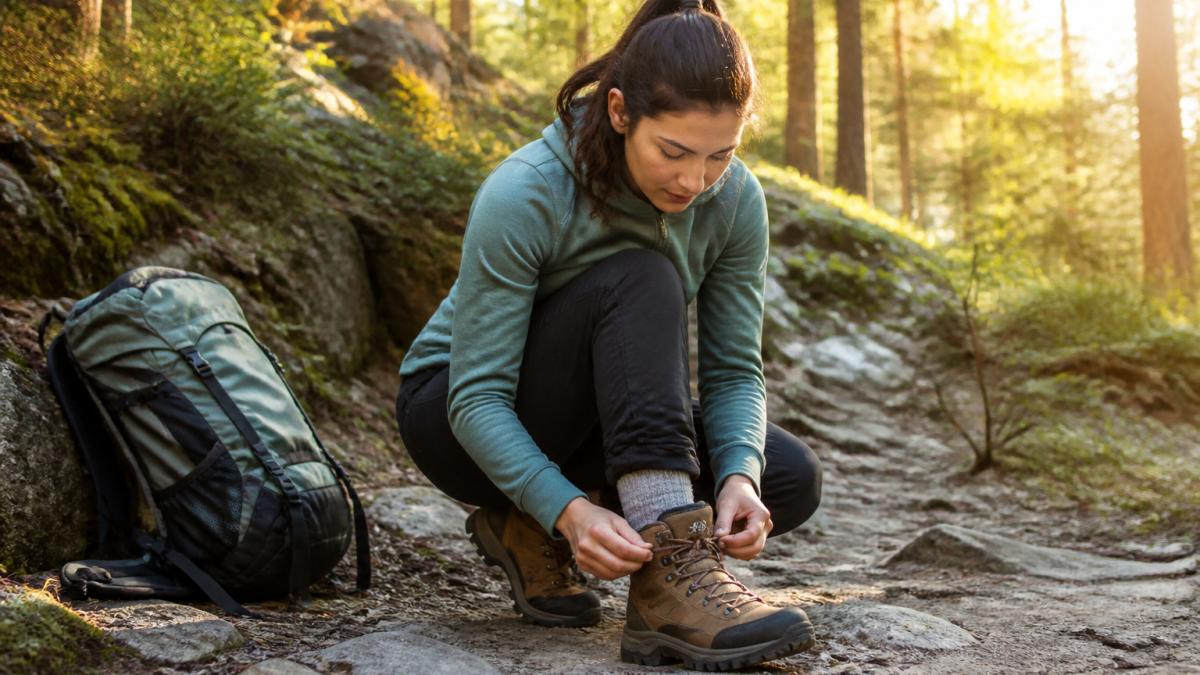
Beginners should look for a waterproof membrane, a grippy outsole, and toe box room. Our ROCKROOSTER Bedrock waterproof hiking boots have a Vibram rubber outsole, a ROOF-TEX waterproof membrane that vents moisture, and a normal-width fit with toe room.
Wear the socks you will hike in and walk before deciding whether boots fit.
Where Beginner Boots Actually Fail
- The heel counter. This is the stiff cup at the back of the boot. If it collapses or softens, your heel slides, and sliding heels cause blisters faster than any other single issue. Press the heel counter from the inside; it should feel firm and resist folding.
- The toe box and rand. The rubber rand wrapping the toe takes the most abrasion on rocky ground. A thin or poorly bonded rand peels away first. Flex the toe area and check that the rand is glued flush with no gaps.
- The membrane. Waterproof membranes fail at seams and at the flex point where the toe box meets the upper. Look for taped or sealed seams inside the boot, and treat any pinhole or crease crack as a future leak.
- The outsole bond. Where the rubber outsole meets the midsole is a common delamination point, especially on budget boots. Press along the edge; any lifting or gapping is a warning sign.
Fit, Sizing and Break-In Checks
- Measure both feet late in the day, when they are largest
- Leave a thumb's width between your longest toe and the boot end
- Confirm your heel stays locked without sliding when you walk uphill
- Test with your hiking socks on, not thin everyday socks
- Walk 20 minutes indoors, then check for rubbing at the heel and instep
- Break boots in over several short walks before a long hike
Shoes, Mid-Cuts or Boots: What a Beginner Actually Needs
Match your footwear choice to the terrain you plan to walk.
If you want to browse actual options, see our hiking boots collection.
What to Wear Hiking for Beginners: Layers That Work
What to wear hiking for beginners can include layers suited to the weather.
Weather is a consideration when deciding what layers to carry. For more, our comfortable hiking gear guide goes deeper into layering.
Packs, Water and Navigation: Matching Gear to Your Hike
Consider the hike when choosing a pack and water capacity. You can shop hydration packs and water bottles that match the hike you are planning.
ROCKROOSTER Bedrock Brown 6 Inch Waterproof Hiking Boots with VIBRAM® →
Our hydration pack with a 70 oz water bladder includes a 2 litre BPA-free bladder, adjustable straps, and splash-resistant nylon.

Navigation and illumination are considerations when planning a hike.
Budget Tiers, Durability and What Beginners Can Safely Buy Used
Durability is an important consideration when choosing hiking gear.
A Realistic Starter Budget, In Priority Order
You do not need to buy everything at once.
- First pass, the non-negotiables. Boots that fit, one pair of proper hiking socks, a small daypack with a hip belt, a water bottle or bladder, and a rain shell. This is the minimum for a short marked trail in mild weather.
- Second pass, the safety layer. A headlamp with spare batteries, a compact first-aid kit with blister care, a paper map of your local area, and an emergency blanket. These are cheap relative to the consequences of needing them.
- Third pass, comfort and range. Trekking poles, a second pair of socks, a warmer mid layer, and a larger pack or hydration capacity once your hikes get longer.
How to Judge Durability Before You Buy
- Seams and stitching. Look for tight, even stitching and reinforced bar-tacks at stress points like strap anchors and pack corners. Loose or single-row stitching at a load point is the first thing to fail.
- Buckles and hardware. Flex every buckle and zip. Plastic hardware that feels brittle or flexes white at the hinge will crack in cold weather.
- Fabric and coating. On packs and shells, check whether the waterproof coating is on the inside face and whether seams are taped. A coating that feels tacky or flaky is already degrading.
- Repairability. The most reliable gear is gear you can fix. Buckles that can be replaced with a spare, poles with serviceable tips and locks, and packs with accessible zips all extend the life of the item far beyond a sealed unit that must be thrown away when one part fails.
- Warranty and parts. A stated warranty and available replacement parts are a practical signal that the maker expects the item to be used hard.
What Beginners Can Safely Buy Used
| Tier | What to prioritize | Buy new or used |
|---|---|---|
| Boots and socks | Fit, waterproofing, outsole | New, always |
| Daypack | Hip belt, seams, zips | New or lightly used |
| Rain shell | Taped seams, hood | New |
| Trekking poles | Locking mechanism, tips | Used is fine |
| Navigation | Map, compass, headlamp | New |
| First aid | Sealed, in-date contents | New, always |
- Safe used: trekking poles (check the locks hold under weight and the tips have life left), a rigid daypack with no seam damage, a stove with a tested valve, and hard accessories like a compass or a stuff sack.
- Risky used: boots and shoes, because a previous owner's foot has already shaped the midsole and the membrane may be compromised; socks and base layers, for hygiene; first-aid contents, because expiry and seal cannot be verified; and any helmet or climbing hardware, where hidden damage is a safety issue.
For more, see our guide to whether expensive hiking gear is worth it and our long lasting hiking boots guide.
Test and Maintain Your Gear Before and After Every Hike
A short walk can be an opportunity to try new gear.
- Flex and inspect boot soles and lacing
- Confirm waterproofing by checking seams and membrane condition
- Test headlamp batteries and carry spares
- Check first aid kit contents and expiry dates
- Rinse and dry the hydration bladder, then check the valve
- Verify pack buckles, straps, and rain cover
Our 5000mm backpack rain cover has a 5000mm waterproof rating and packs into its own pouch.

Build Your Starter Kit at Fitness Pro Living
A starter kit can include hiking boots, water capacity, and other hiking essentials.
Fitness Pro Living offers hiking boots, hydration packs, first aid kits, and rain covers. Our gear is made to work better and last longer.
Get started with Fitness Pro Living.
Frequently Asked Questions
What gear does a beginner need for hiking?
A beginner hiking gear checklist can help organize what to consider for a hike.
What are the 10 essentials for hiking?
The 10 essentials for hiking are a packing framework. Fitness Pro Living offers a [173-piece first-aid kit](https://fitnessproliving.com/products/173pcs-large-first-aid-kit-portable-bag-for-outdoor-hunting-hiking) and a [backpack rain cover](https://fitnessproliving.com/products/backpack-rain-cover-waterproof-5000mm-10l-90l).
How do I choose hiking boots as a beginner?
The ROCKROOSTER Bedrock 6-inch boot has a Vibram rubber outsole, a breathable ROOF-TEX waterproof membrane, and an anti-fatigue foam insole.
What should I wear for my first hike?
Consider the weather when choosing what to wear for a hike.
Do beginners need a hiking backpack?
Fitness Pro Living offers a [hydration pack with a 2 litre bladder](https://fitnessproliving.com/products/hydration-pack-with-70-oz-2l-water-bladder). Its listing specifies adjustable shoulder, chest, and waist straps.
How can I stay safe and prepared on a beginner hike?
Planning a hike can include considering the route, weather, and gear you will take.
