

Table of Contents
- Best Camping Gear for Weekend Trips: What Actually Earns Its Space
- Shelter: Tents, Rain Tarps, and Quick Setup
- Sleep Systems: Sleeping Bags, Pads, Air Mattresses, and Cots
- Cooking, Coolers, and Water Access at the Campsite
- Lighting, Clothing, and Weather-Ready Layers
- Your Weekend Camping Checklist: What to Pack Before You Leave
- Camping Essentials for Beginners: The Short Version
- Family Camping Gear: What Changes With Kids in Tow
- Frequently Asked Questions
Last Updated: October 8, 2026
Best Camping Gear for Weekend Trips: What Actually Earns Its Space
The best camping gear for weekend trips earns its place in a packed car, not the longest feature list.
A weekend trip is a different discipline from backpacking: you drive to a campground, stay one or two nights, and pack up before you have broken in the tent.
Below, we break down each category by what a two-night trip demands.
REI's beginner camping resource library
How to Compare Weekend Camping Gear Side by Side
Judge weekend gear on five criteria, in this order: setup time, packed size, weather resistance, comfort, and repairability. Price sits last, because cheap gear that fails on night one costs more than you saved.
Rate each item 1 to 5, weight setup time and weather resistance double, then compare totals. A dome tent that pitches in three minutes usually outscored a lighter tent that takes fifteen.
Budget Tiers: What a Complete Weekend Kit Costs
We do not publish fixed prices, because a complete kit depends on what you already own and how many people you are outfitting. Check current pricing on our site or request a quote.
Shelter: Tents, Rain Tarps, and Quick Setup
A freestanding dome tent is the right default for weekend trips: it pitches without stakes, handles light rain, and packs small enough for a car trunk.
Rain protection is where cheap tents fail. A rain tarp over the tent and a ground tarp underneath extend the life of the floor and fly. Set the tarp slightly smaller than the tent footprint so rain does not pool underneath.
For a family camping setup, a cabin-style tent with a divider gives kids their own space and stays usable in bad weather. It weighs more and takes longer to pitch, a fair trade when you are not carrying it.
Sleep Systems: Sleeping Bags, Pads, Air Mattresses, and Cots
Sleep is the biggest factor in whether a weekend trip feels restful or rough. A sleeping bag keeps you warm, but the pad underneath does most of the work: the ground pulls heat out of your body all night, and a pad with decent insulation blocks that loss. A $40 bag on a good pad usually beats a $200 bag on a bare floor.
Match the bag to the low, not the average
Temperature ratings describe the lowest temperature at which an average sleeper stays comfortable, not the temperature you will be warm at. Buy a bag rated about 10°F colder than the coldest night you expect; for a three-season weekend kit, 20°F to 30°F covers most spring, summer, and fall campgrounds in temperate climates. Look for these specifics:
- Comfort rating vs. limit rating: the comfort rating is what most people should plan around; the limit rating assumes a warm sleeper in a baselayer.
- Fill type: down packs smaller and lasts longer but loses insulation when wet; synthetic dries faster and costs less, which matters for car camping where a damp bag can be dried on a line.
- Shape: a rectangular bag gives room to move and works for couples who want to zip two together; a mummy bag is warmer per ounce but feels restrictive.
Pads are rated in R-value
Pad insulation is measured by R-value, a number that describes resistance to heat loss. For weekend trips, a simple rule of thumb:
- R-value 1-2: summer only, warm nights, low elevation
- R-value 3-4: three-season camping, the safe default for most weekend trips
- R-value 5+: cold-weather camping, snow, or anyone who sleeps cold
Air mattresses are comfortable but usually have low R-values unless insulated, and they leak. Self-inflating pads balance pack size and insulation. Closed-cell foam pads are cheap, indestructible, and never leak, a good backup layer. Cots suit anyone with back trouble, but they are heavy and bulky, so they only make sense for drive-in sites.
The three weekend sleep setups
- Car camping, comfort first: insulated air mattress or cot, rectangular bag rated to your expected low, real pillow from home.
- Drive-in campground, balanced: self-inflating pad (R-value 3-4), 20°F-30°F bag, compressible travel pillow.
- Short backpacking weekend: mummy bag, inflatable pad with a stated R-value, inflatable pillow, and a closed-cell foam sit pad that doubles as backup insulation.
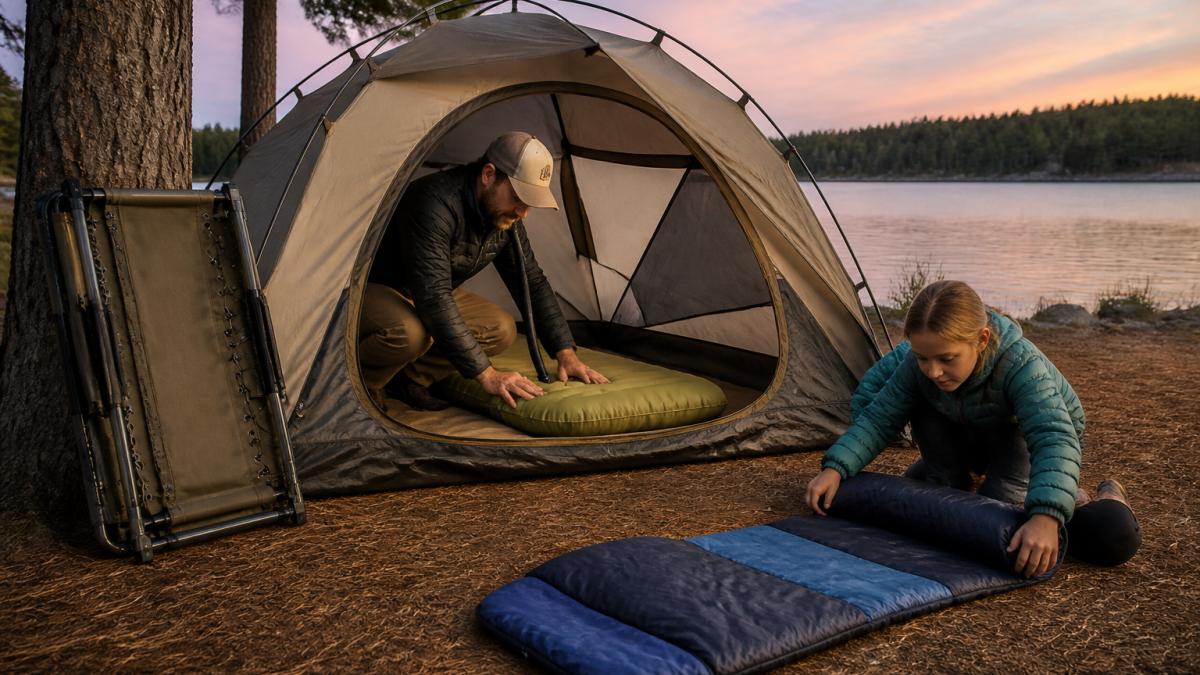
Add a travel pillow and a camping blanket for shoulder seasons. A bag rated colder than you expect is never wasted, because a cold night ruins a trip faster than rain. Kids' bags should be rated for the same temperatures as adult bags.
Cooking, Coolers, and Water Access at the Campsite
A two-burner camping stove covers nearly every weekend meal: one burner for a pot, one for a pan, so you cook real food instead of rehydrating it. Bring a pot, a pan, a spatula, a cutting board, and a lighter in a waterproof container.
Stove and fuel choices
- Propane two-burner: the default for car camping. Runs on 1 lb disposable cylinders or a refillable tank with an adapter. One 1 lb cylinder typically covers a weekend of simple meals for two to four people.
- Butane single-burner: cheap and compact, but butane struggles in cold weather and the canisters are not refillable.
- Liquid-fuel or multi-fuel: heavier and fussier, but reliable at altitude and in cold. Overkill for most weekend trips.
Cooler sizing and ice math
For two nights, a 30-50 quart cooler holds food and drinks for two to four people. Bring one block of ice per day, plus a bag of cubed ice for drinks. Block ice melts slower because it has less surface area per volume.
Store food in the car or a locked container overnight, never in the tent. In bear country, use the campground's food locker or hang a bear bag well away from your sleeping area, food in a tent is the most common cause of wildlife incidents.
Water access and treatment
Water access depends on your campground. If potable water is available, bring a refillable container per person, roughly one gallon per person per day for drinking, cooking, and cleanup. If not, you have three options:
- Gravity filter: hang it and let gravity do the work. Best for groups and basecamp-style weekend trips.
- Pump filter: fast for small quantities, but more effort per liter.
- Chemical treatment (tablets or drops): lightest option, but takes 30 minutes or more to work and does not remove sediment.
Bring backup bottled water for the first night so you are not filtering in the dark after a long drive.
| Category | What to Bring | Why It Matters |
|---|---|---|
| Shelter | Freestanding dome tent, rain tarp, ground tarp | Fast setup, rain protection |
| Sleep | Sleeping bag, pad or cot, travel pillow | Warmth and back support |
| Cooking | Two-burner stove, fuel, pot, pan, utensils | Real meals, not just snacks |
| Storage | Cooler with block ice, dry sacks | Food safety, dry clothes |
| Water | Refillable containers, filter or tablets | Hydration, backup supply |
Lighting, Clothing, and Weather-Ready Layers
Lighting is the category people forget and then miss most. Pack one lantern for the campsite and a headlamp per person: the lantern lights the table, the headlamp keeps your hands free.
Clothing for changing weather follows a layering rule:
- Base layer: a moisture-managing shirt that wicks sweat
- Mid layer: a fleece or light jacket for cool evenings
- Outer layer: a rain shell that blocks wind and water
Even in summer, campground nights run colder than your backyard. A long-sleeve layer and a compact rain jacket take up almost no space and prevent the mistake that ends a trip early.
National Park Service guidance on camping safety and weather preparedness
Your Weekend Camping Checklist: What to Pack Before You Leave
A weekend camping checklist prevents the two most common trip failures: forgotten essentials and gear that never gets used. Pack by category, then cut anything you have not touched on your last two trips.
- Tent, rain tarp, ground tarp, stakes
- Sleeping bags, pads or cots, travel pillows
- Camping stove, fuel, pot, pan, utensils, lighter
Repair gear separates a smooth trip from a cancelled one. A roll of tape and a spare stake weigh almost nothing and solve most campsite emergencies.
Camping Essentials for Beginners: The Short Version
Camping essentials for beginners come down to shelter, sleep, food, water, light, and layers. Everything else is comfort, added on later trips once you know what you actually miss.
If you are buying your first kit, start with these six items and nothing more.
For a four-day trip rather than a weekend, camping gear for a 4-day trip adds roughly one more day of food, an extra set of clothes, and a larger cooler.
Family Camping Gear: What Changes With Kids in Tow
Family camping gear shifts priorities toward space, safety, and speed: a larger tent, more sleep capacity, and lighting kids can manage themselves.
Three changes matter most for families:
- Bigger shelter: a cabin tent with a divider, not a tight dome
- More seating: folding chairs and a camp table so meals happen off the ground
- Simpler cooking: one-pot meals and easy snacks reduce cleanup time
Buy gear that survives being dropped, dragged, and packed by children. Durability matters more in a family kit than any other, and that is where Fitness Pro Living focuses: gear made to work better and last longer, loved by our community of adventurers.
Frequently Asked Questions
What should I bring on a weekend camping trip?
A complete weekend camping gear setup covers shelter, sleep, cooking, water, light, and clothing. Bring a tent with a rain tarp, a sleeping bag and pad or air mattress, a camping stove, a cooler, a lantern, and layers for changing weather. Add a first aid kit, repair tape, and a portable charger. Fitness Pro Living carries many of these essentials in one place, so you can build a full kit without ordering from five different suppliers.
What camping essentials do beginners need for a weekend?
Beginners can start with a freestanding dome tent, a sleeping bag rated for colder-than-expected overnight lows, a foam or inflatable pad, a simple two-burner stove, a cooler, and a battery lantern. Skip specialty items like hammocks or backpacking stoves until you know your camping style. Focus on easy setup and beginner-friendly gear first, then upgrade individual pieces as you learn what you actually use on each trip.
What should I pack for a 4-day camping trip that a weekend trip doesn't need?
A 4-day trip needs more food storage, extra fuel, and a larger water supply than a two-night weekend. Add a second cooler or dry sacks for food, a spare lantern or headlamp batteries, and an extra set of clothing layers. If you plan to hike during the trip, bring a daypack for short excursions. Fitness Pro Living's backpacks and dry sacks are backed by 227 reviews for their durability.
How do I choose a tent and sleeping bag for a weekend camping trip?
Match the tent size to your group: a 4-person dome tent fits two adults comfortably with gear. Look for a freestanding design with quick assembly and a separate rain tarp for wet weekends. For sleeping bags, check the temperature rating against your trip's overnight lows and add a sleeping pad for insulation. If you camp with family, consider a larger tent and kids' sleeping bags sized for smaller bodies.
Planning a weekend trip should take an evening, not a week of research. The challenge is not finding gear; it is choosing the few pieces that will still work on your tenth trip, not just your first. Fitness Pro Living builds camping and hiking gear designed to hold up to repeated weekends in the woods, from durable tents and furniture to hiking backpacks and practical tools for the trail. Shop now and get a kit you can pack once and trust every season.